HVAC systems
The HVAC systems covered in this post include furnaces, central air conditioning, radiant heating, mini splits, exhaust fans, and general ductwork. You want to meet the minimum functional standard expected in your market. In many regions, even as far north as Ohio, central air is often expected. If a property lacks forced air heating and cooling, you may need to add air conditioning, in the form of mini splits, to make the home competitive and appeal to buyers at the top of the market.
Furnaces
Replacing a furnace just because it’s old is one of the fastest ways to burn through a renovation budget. Age alone doesn’t make a furnace a liability. Many units run safely and efficiently for decades with only basic maintenance. I once inspected a house with a functional furnace from the 1960s. The key is knowing when a furnace is still a good candidate for continued service and when replacement is unavoidable. A functioning furnace with no major safety issues is often better left in place, especially if you’re renovating for resale and the system isn’t a deal breaker in your market. I suggest that you plan to replace any furnace older than 40 years. Otherwise, before spending money on a new unit, inspect the existing one thoroughly.
How to inspect a furnace:
- The condition or the heat exchanger: You usually can’t tell the condition of the heat exchanger without taking the furnace apart. Watch the burner flame when the blower comes on. If the flame wavers, lifts, or gets disturbed, that’s an indicator of a breach in the heat exchanger. You can call a technician to perform a more extensive analysis by measuring for combustion gas in the supply air ducts.
- Burner flame quality: The flame should be steady and blue, not yellow, lazy, or lifting.
- Combustion chamber cleanliness and soot buildup.
- Blower operation: Noise levels, and bearing wear.
- Air filter: The condition of the filter and signs of dust bypass.
- Exhaust venting: Ensure proper draft, secure connections, and no corrosion or collapse.
- General cabinet rust: Water damage, and signs of past leaks or condensation issues.
- Age of the unit: You can usually find the age of the HVAC equipment by searching the serial number online. Compare the age to the expected lifespan, but treated as context, not the deciding factor.
- Maintenance history: If available, check the maintenance history. A well maintained older furnace often outperforms a neglected newer one.
Central air conditioning
In most markets today, central air isn’t a luxury, it’s a basic expectation. Even in northern states, buyers assume a house will have a functional cooling system. Fortunately, central air is one of the easier systems to keep alive. A condenser that looks tired or has some age on it can often be serviced, cleaned, or repaired for a fraction of the cost of replacement. Most AC failures come down to neglected maintenance, clogged coils, bad capacitors, old thermostats, or minor refrigerant issues rather than catastrophic compressor failure. For investors, the priority is to get the system functioning reliably and safely without dumping money into unnecessary full replacements. If a new system is required, determine whether or not you would benefit from having a new furnace installed at the same time for a modest discount.
How to inspect central air conditioning:
- System age: Age can be a helpful context, but not the final word. Condensers commonly last 15–20 years, or more, and evaporator coils slightly less. Use serial numbers to verify age and compare it against the expected lifespan, but don’t let age alone dictate replacement.
- Condenser condition: Check for bent fins, damaged fan blades, heavy rust, oil stains around refrigerant connections (a sign of leaks), and abnormal noise from the fan or compressor. Excessive vibration or clicking can indicate compressor wear.
- Evaporator coil and air handler: Look for rusted drain pans, clogged condensate lines, biological growth on the coil, and signs of historic overflow. Any evidence of repeated clogging or overflow is a red flag that must be corrected before resale. Ensure the blower operates smoothly and quietly.
- Refrigerant lines: Inspect the insulation on the suction line (the larger line). If it’s deteriorated, missing, or saturated with oil, it can impair efficiency or signal a leak. Check for kinks in the line set, which can reduce refrigerant flow.
- Temperature split: This is the simplest test of basic performance. Measure the air temperature entering the return and compare it to the temperature coming from the supply ducts. A typical system should show a 15–20°F drop. A lower split may indicate low refrigerant charge, duct leakage, a dirty coil, or airflow problems.
- Electrical components: Confirm that the disconnect, contactor, capacitor, and wiring are secure and show no signs of overheating or burning. A failing capacitor is one of the most common AC problems and an inexpensive repair.
- Drainage: Ensure the condensate line is free flowing, a clogged condensate line can cause overflow, water damage, and mold.
Radiant heat and electric baseboard systems
Radiant heat and electric baseboard systems are common in older homes and homes further north. They provide quiet, even heat and avoid the ductwork issues that come with forced air, but from an investment standpoint they can be a mixed bag. Many buyers view them as outdated or expensive to repair. Electric baseboards are simple and reliable but often carry the perception of being cheap and inefficient, which can limit a property’s appeal in competitive markets. Replacing either system outright is rarely the first move. If a boiler or electric baseboards are functional and safe, repairing and servicing them is almost always more cost effective than a full conversion to forced air, in terms of appraised or market value. Boilers can run for decades with proper maintenance, and most issues can be repaired without replacing the entire system. Electric baseboards are even simpler, a failed thermostat or a damaged heating element is usually inexpensive to fix. Your goal is to determine whether the system is safe, functional, and predictable. If it’s working reliably and meets the expectations of your market, keep it. If it’s inefficient, mismatched to the property, or so outdated that repairs become too costly, it may be smarter to plan for a conversion to forced air.
Things to inspect on radiant/boiler systems:
- Boiler condition: Rust, leaks, soot buildup, and burner performance.
- Circulator pumps: Noisy operation, leaking gaskets, or pumps that fail to move water.
- Zone valves: Stuck, slow, or unresponsive valves are a common cause of uneven heating.
- Expansion tank: If the expansion tank is waterlogged or failing, pressure will spike or fluctuate abnormally.
- Radiator condition: Leaks, corrosion, missing bleed valves, or radiators that never fully warm.
- Manifolds and piping: Signs of old repairs, corrosion, or deteriorated tubing (especially in older copper or steel systems).
- Combustion safety: Proper draft, no backdrafting, and correct venting.
- Slab embedded systems: Watch for slab leaks, unexplained water loss, or chronically cold sections of floor.
Things to inspect on electric baseboard heating:
- Thermostats: Many older units fail gradually and cause inconsistent heat.
- Heating elements: Look for damage, discoloration, or units that remain cold even with power.
- Undersized units: Baseboards often don’t meet heat load demands in larger rooms.
- Electrical wiring: Frayed conductors, loose connections, or aluminum wiring need attention.
- Panel capacity: Ensure the home’s electrical service can handle multiple high draw circuits.
- Safety clearances: Furniture or drapes too close to a baseboard heater can pose a fire hazard.
- Age and condition: Older, low efficiency baseboards may still work but will cost more to operate and can be a marketability issue.
Mini Splits
Mini split heat pump systems are one of the most versatile pieces of HVAC equipment you can install in a house. They provide heating and cooling in one package, they don’t require ductwork, and they can be the most cost effective option when you’re renovating any space where running new ducts would be expensive or impractical. The downside is that they aren’t cheap, but mini splits are repairable, serviceable, and often last 12-20 years with basic maintenance. Replacement becomes unavoidable when the compressor fails, the refrigerant circuit is compromised, or the system is so oversized or undersized that comfort is impossible to fix. As a rule of thumb, I’d plan on full replacement if the system is over 20 years old or if the compressor or outdoor coil is shot. Otherwise, most issues can be repaired for far less than the cost of a new install. Consider installing a new system when you’re renovating a space with no existing ductwork.
How to inspect a mini split:
- Check outdoor coil condition: Look for crushed fins, corrosion, or ice buildup. Excessive corrosion on coastal homes is a red flag.
- Check indoor head cleanliness: Dirty coils or blower wheels reduce capacity and create odor complaints.
- Listen for compressor and fan noise: Rattling, grinding, or excessively loud operation usually indicates bearing wear or a failing fan motor.
- Confirm proper drainage: Inspect the drain line for clogs, improper slope, or signs of past leaking on walls.
- Look for refrigerant leaks: Oil stains on line sets, flare fittings, or around the service valves are common leak indicators.
- Evaluate line set installation: Kinked copper, missing insulation, and sloppy wall penetrations point to amateur installs.
- Check the age via serial number: Most major brands have online lookup tools. As always, treat age as context, not a strict replacement rule.
- Run the system in both heating and cooling: Confirm that it ramps up, modulates, and maintains setpoint without erratic cycling. Do not run in cooling mode if the outside temperature is below 60 degrees fahrenheit.
- Assess overall sizing and placement: Indoor heads should be positioned to serve the intended room. Poor placement often explains comfort issues more than equipment failure.
Exhaust fans
The primary area of concern for exhaust fans is the bathroom. Beyond code compliance, buyers now expect this feature, and its absence can make the home feel outdated and reduce the perception of modernity.
“Bathrooms, water closet compartments and other similar rooms shall be provided with aggregate glazing area in windows of not less than 3 square feet (0.3 m²), one half of which must be openable. Exception: The glazed areas shall not be required where artificial light and a local exhaust system are provided. The minimum local exhaust ventilation rates shall be determined in accordance with Section M1507. Exhaust air from the space shall be exhausted directly to the outdoors.” IRC Section R303.3
How to inspect exhaust fans:
- Noisy fan: This can be a symptom of worn or loose bearing or misaligned blades. Plan to replace a noisy fan.
- Toilet paper test: Rip off a small piece of toilet paper, observe if it sticks to the fans intake fins while the fan is running. This will indicate the effectiveness of the fans flow rate.
- Inspect the attic: Be sure that the fan is exhausting to the exterior of the house, not just dumping into the attic.
General ductwork
All finished spaces should have adequate climate control, which requires properly sized supply ducts and a clear return path, whether via a return duct, an undercut door, or a transfer grille. If you have finished space that lacks climate control, you may consider adding ductwork, radiant heat, or a mini split to satisfy appraisal requirements.
During inspection, the ductwork should be checked for asbestos containing materials. According to EPC guidelines, asbestos on supply ducts can often be sealed or encapsulated, while asbestos on return ducts must be replaced, as negative pressure in the return system could draw airborne fibers into the living space. Ensuring both supply and return pathways are functional and safe is essential for maintaining indoor air quality and proper system performance. Figure 2.4.1 shows what is likely asbestos containing duct wrap, which was commonly used from the 1940s through the 1980s.
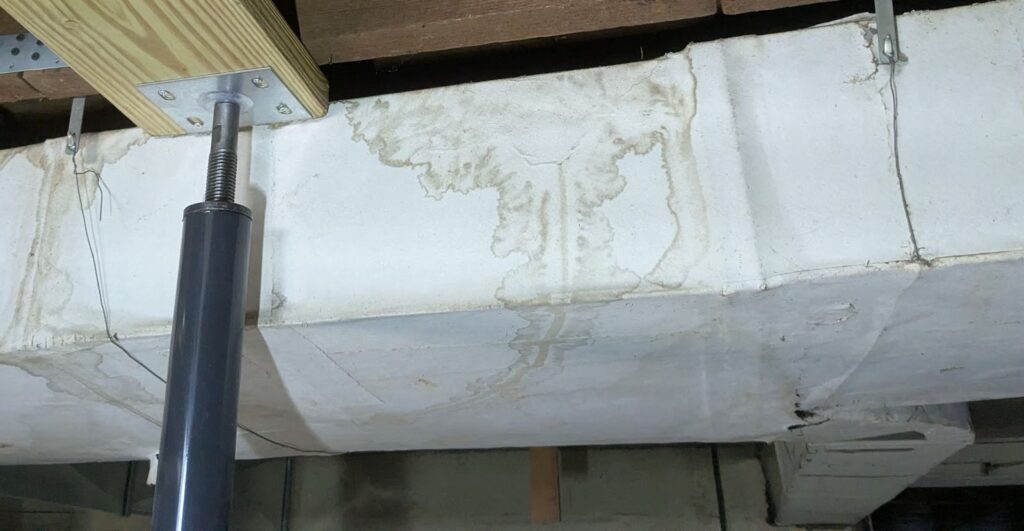
Figure 2.4.1